
The Quantitative Ability (QA) section carries significant importance in the Common Admission Test (CAT), India’s gateway to elite management education. It tests aspirants’ numerical power and problem-solving skills under pressure. Alongside QA, CAT features two other core areas: Verbal Ability & Reading Comprehension (VARC) and Data Interpretation & Logical Reasoning (DILR). While many candidates hesitate to tackle the math-oriented QA questions, mastering this section proves essential for securing admission to premier Indian Institutes of Management (IIMs) and other top B-schools.

Core Purpose
Quants evaluate Class 9-10 level concepts applied creatively—no calculus or advanced math required. Spanning 22 questions worth 66 marks in a strict 40-minute section, it demands conceptual clarity, quick calculations, and logical shortcuts. Arithmetic (35-45%) dominates, but balanced mastery across algebra, geometry, numbers, and modern math unlocks 99+ percentiles, directly impacting IIM calls.
Why Quants Matter
Quantitative Ability (QA), or Quants, holds pivotal importance in CAT as one of three equally weighted sections (22 questions, 66 marks), directly influencing overall percentile and IIM shortlists. QA performance often differentiates candidates—top IIMs demand 90+ sectional percentiles alongside 98-99+ overall. Arithmetic-heavy questions (35-45%) yield quick wins for engineers, while balanced scores prevent elimination during cutoff stages.
Quants mirrors real business scenarios: profit-loss analysis, investment calculations, ratio-based decisions. Mastering percentages, TSD, and algebra sharpens analytical thinking essential for consulting (McKinsey), finance (Goldman Sachs), and operations roles post-MBA.
How to Prepare QA for CAT 2026
The Quantitative Ability (QA) section in CAT preparation emphasizes mastering mathematical fundamentals from Classes 9 and 10. Nearly two-thirds of CAT’s Quant syllabus draw directly from core arithmetic and algebra, making conceptual clarity the cornerstone of effective CAT 2026 readiness.
However, many candidates—particularly non-engineers—often wonder: “How can I excel in Quantitative Ability?” With recent CAT QA trends leaning heavily toward arithmetic, achieving rapid calculations, precision, and regular practice now determines success in scoring 40+ marks.
As QA remains CAT’s most consistent section, strategic planning and selective question attempts can dramatically elevate your percentile. Priorities mock test practice to uncover strengths, enhance speed, and dominate high-yield areas like Arithmetic and Algebra.
Exam Pattern of QA for CAT 2026
Quantitative Ability has a particular exam pattern. By understanding the pattern, it is easy for aspirants to learn QA strategically and plan accordingly.
| Particular | Detail |
| No. Of Questions | 22 |
| Type of Questions | MCQs & TITA |
| Marking for MCQs Questions | +3 for correct answer -1 for incorrect answer |
| Marking for TITA Questions | +3 for correct answer No negative Marking |
| Total Time Allotted | 40 minutes |
Preparation Tips for Quantitative Ability
- Build Core Speed Foundations
CAT tests both aptitude and velocity. Prioritize calculation acceleration through Vedic Math shortcuts, approximation techniques, and multiplication tables up to 25. Test various methods during this phase to adopt personalized high-speed strategies. Know the basic terminologies like what is Co– Prime Numbers, prime numbers, etc.
- Progressive Question Practice
Once basics solidify, tackle NCERT Class 9-12 problems escalating from simple to moderate. These free resources eliminate book dependency while honing accuracy and pattern recognition before advancing specialized CAT material like Arun Sharma or Route99 modules.
- Intermediate Accuracy Focus
Shift to medium-difficulty questions requiring concept fusion (e.g., P&C with probability). Sacrifice initial speed for 90%+ accuracy; revisit formula applications until instinctive. Gradually reintroduce timing once conceptual gaps close.
- Prioritize your strong topic
Focus on Quality, not on Quantity. Do not rush to cover the whole syllabus, instead identify your strong points and work on its efficiency. Generally, students focus on their weak topic and spend so many days learning, yet could not become experts in that. Rather, one should focus on their strong topic and make sure to attempt questions from that topic with 100% accuracy.
- Mock Practice
Learning only the basics or solving sums is not sufficient for achieving mastery in Quants. Test your practice every day. Try to solve as many mocks as possible, so that you can know how much time you spend on a question. It helps you solve more questions with less time and accuracy.
Weightage of each topic of Quants
Quantitative Ability (QA) typically features 22 questions, with Arithmetic dominating at 35-45% weightage, followed by Algebra (25-30%), Geometry/Mensuration (15-20%), Number Systems (10-15%), and Modern Math (5-10%).
| Topic | Expected Questions | % Percentage | Key Sub – Topic |
| Arithmetic | 8 – 10 | 35 – 45% | Percentage, Profit/loss, Averages, Mixture, TSD/W |
| Algebra | 5 – 7 | 25 – 30% | Equations, Functions, Logarithms, Inequalities |
| Geometry -Mensuration | 3 – 5 | 15 – 20% | Triangles, Circles, Co-ordinates Geo, Volumes |
| Number System | 2 – 4 | 10 – 15% | Factors, LCM/HCF, Divisibility, Remainder |
| Modern Math | 1 – 3 | 5 – 10% | Permutations/Combinations, Probability, Sets |
Strategy for tackling difficult topics in Quantitative Ability

- Geometry
Geometry contributes 3-5 questions (9-15 marks) in CAT QA, focusing on triangles (40%), circles (25%), coordinate geometry (20%), and mensuration (15%).
- Triangle Dominance: Memorise 15 key theorems (Pythagoras, similarity, congruence, median formulas). Practice 50+ triangle problems weekly—area ratios, angle chasing, 30-60-90 triangles.
- Circle Properties: Master tangent-secant, chord theorems, angle in semicircle. Draw diagrams for cyclic quadrilaterals (opposite angles sum=180°).
- Visualise First: Sketch every problem. Use a rough sheet for coordinating geometry (distance formula, section formula). Label angles/sides immediately.
- Speed Hacks/ IMP Formula
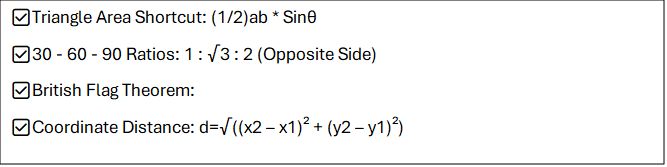
- Practice Progression
- Week 1 – 2: NCERT Class 9-10 (50 pages/day)
- Week 3 – 4: Arun Sharma LOD 1-2 (30 Questions/day)
- Week 5+: Last 10 years PYQs + Route99 Sectional Tests
- Common Traps to Dodge
| Traps | Fix |
| Lengthy Mensuration | Memorize Formulas |
| Coordinate Calculation Errors | Practice Quadrant Signs (+x+y, -x+y, etc.) |
| Angle chasing confusion | Mark “given angles” first, work systematically |
| 3D visualization | Practice cube/cuboid unfolding patterns |
- Time, Speed & Distance
TSD delivers consistent 2-3 questions per CAT, testing relative motion, average speed, and work-rate concepts through trains, boats, escalators, and races.
- Core Formulas
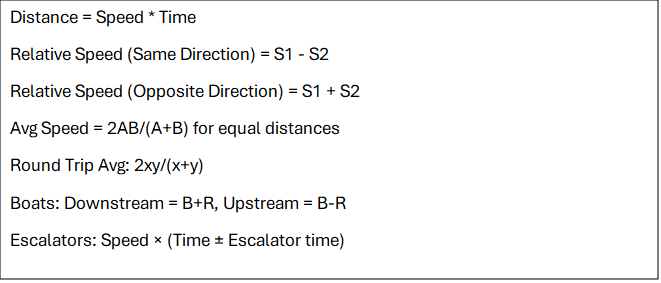
- Question Types & Attack Strategy
| Type | Expected Questions | Approach |
| Relative Motion | 1 – 2 | Draw diagram → Identify relative speed → Time = Distance/Relative Speed |
| Average Speed | 1 | Use harmonic mean for unequal distances |
| Trains/Boats | 1 | Convert all to same units (km/hr ↔ m/s: ×5/18) |
| Races | 0 – 1 | When A beats B by X meters → Ratio = (D+X) 😀 |
- Speed Hacks (<90 seconds solve time)
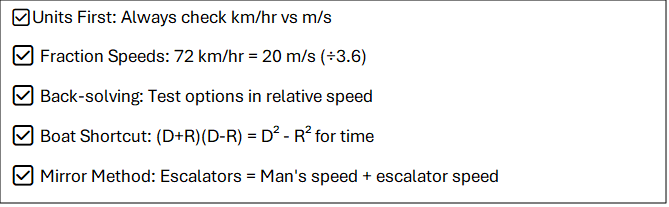
- Practice Roadmap
- Days 1-7: 50 basic NCERT problems (speed-distance-time word problems)
- Days 8-14: Arun Sharma LOD 1-2 (30/day) + 5 PYQs
- Days 15-21: LOD 3 + Route99 sectional tests (20/day)
- Days 22-28: 2 full mocks/week → Analyse TSD errors
- Top 5 Traps & Fix
| Trap | Fix |
| Unit mismatch (km/hr vs m/sec) | Convert: km/hr × 5/18 = m/s |
| Average speed = arithmetic mean | Use: 2ab/(a+b) for equal distance |
| Escalator direction confusion | Draw man’s position vs escalator movement |
| Relative speed wrong direction | Same direction = subtract, Opposite = add |
| Circular track lap problems | Relative speed × time = distance covered |
3. Average Mixture & Alligations
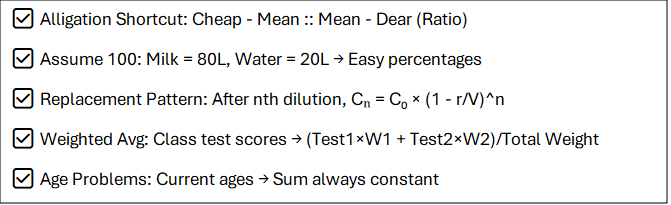
Averages, Mixtures, and Allegations deliver consistent high-ROI questions in CAT QA, testing weighted averages through ratio logic rather than complex algebra. Though it’s a complex topic, once you learn to apply the formula, you can crack any question type from this topic.
- Cora Formulas
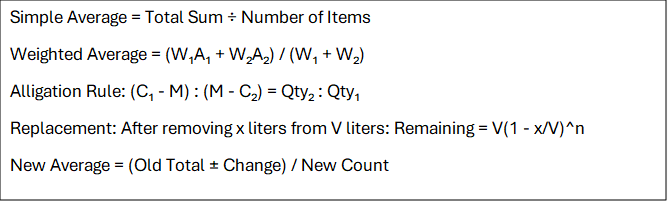
- Question Type & Attack Strategy
| Type | Expected Questions | Approach |
| Simple/Weighted Avg | 1 –2 | Convert to totals: Avg × N = Total value |
| Alligation (2 ingredients) | 1 | Draw crisscross diagram |
| Mixture Replacement | 1 | Track concentration after each step |
| Multiple Mixtures | 0 – 1 | Assume quantities (100 liters total) |
- Speed Hacks (<90 Seconds Solve Time)
- Practice Roadmap
- Days 1-7: NCERT averages (30/day) + basic alligation
- Days 8-14: Arun Sharma LOD 1-2 (25/day) + 5 PYQs
- Days 15-21: LOD 3 + Route99 sectional tests (20/day)
- Top 5 Traps and Fixes
| Traps | Fix |
| Arithmetic mean vs weighted mean | Use weights for unequal quantities |
| Alligation direction confusion | Quantity of cheaper : Quantity of dearer |
| Replacement calculation error | Track remaining quantity each step |
| Age problems (future/past) | Sum of ages remains constant |
| Multiple replacements | Use the formula, don’t calculate step-by-step |
- Tips to remember while tackling Quantitative Questions
Learn to move on: Generally, students get stuck on one question and try to solve it without settling the time limit. At the end, they would not be able to spare time for other easier questions and lose marks. So do not spend more than 2 minutes on a particular question; if you don’t get an answer, move forward to another one.
Don’t always rely on shortcuts: Though a shortcut approach is easy and doable for solving the questions, some questions should only be solved by the traditional method, as it won’t consume so much time and give a proper answer. So, along with shortcuts, try to solve the question with a traditional approach.
Question Selection: In Quantitative Ability (QA), question selection is a must. Identifying which question can save the maximum time, and on which method you are confident, is necessary. By giving mocks, you can figure this out.
Improve Calculation Skill: Though a calculator is given in the CAT exam, students should learn to calculate manually to conserve time. Students should do their basic calculations manually, and for that, learning tables, square roots, and cube roots is essential.
Speed Limit: Focus on your speed on a question. Try to solve the maximum number of questions in the minimum time with accuracy. Noting the time spent on each question helps you to improve your speed. The speed won’t come on the first day; it will come eventually with constant practice.
Simplify your question, don’t complicate it: Sometimes students are confused at the time of application of the method, and so they complicate the question more. Rather, try to solve it step by step and do not complicate it.
General Tips for mastering Quantitative Ability
- Solve 20-25 questions across Arithmetic, Algebra, Geometry, and Modern Math to build topic familiarity and exam confidence
- Tackle 3 sectional tests weekly + 50 numerical problems to master question variations and develop selective solving strategies
- Practice Vedic Math, tables (1-25), approximation techniques—target <90 seconds per moderate question
- Plan 14-17 questions (12 Arithmetic + 2-3 each from Algebra/Geometry) based on mock performance and comfort zones
- Maintain 80%+ precision even if slower; negative marking (-1) hurts more than unattempted questions
- Test 3-4 strategies (question order, time allocation) across 2 full mocks + 3 sectionals weekly to finalize exam-day approach
Best Books for the preparation of Quantitative Ability
| Book | Author |
| How to prepare for quantitative aptitude for CAT | Arun Sharma |
| Quantum CAT | Sarvesh Verma |
| The person guide to quantitative aptitude | Nishit K. Sinha |
| Quantitative Aptitude | R.S.Sharma |
Conclusion
CAT QA preparation has evolved significantly with abundant online resources, topic-specific videos, previous year papers, and mock test platforms, yet systematic practice and conceptual clarity remain the true differentiators. Unlike VARC or DILR, where natural aptitude plays a role, QA rewards disciplined skill-building through structured concept sessions, regular topic-wise practice, sectional tests, and full-length mocks that refine both accuracy and speed. Classroom guidance from Route99 proves invaluable, offering conceptual classes covering high-weightage Arithmetic (35-45%), Algebra, and Geometry, alongside daily modulus, sectional tests featuring personalized error analysis, and mock series that mirror exact CAT 2026 patterns. With Route99’s expert-led roadmap and consistent execution, aspirants transform QA from a weakness into a 99+ percentile strength—enrol today to launch your IIM journey with Quant mastery!